
Map of Odysseus' journey: every stop in the Odyssey
After ten years of war at Troy, Odysseus needs ten more to get home to Ithaca. Here is every stop on the way, in the order Homer tells it: where each place is thought to be today, what happened there, and which book of the Odyssey to read.
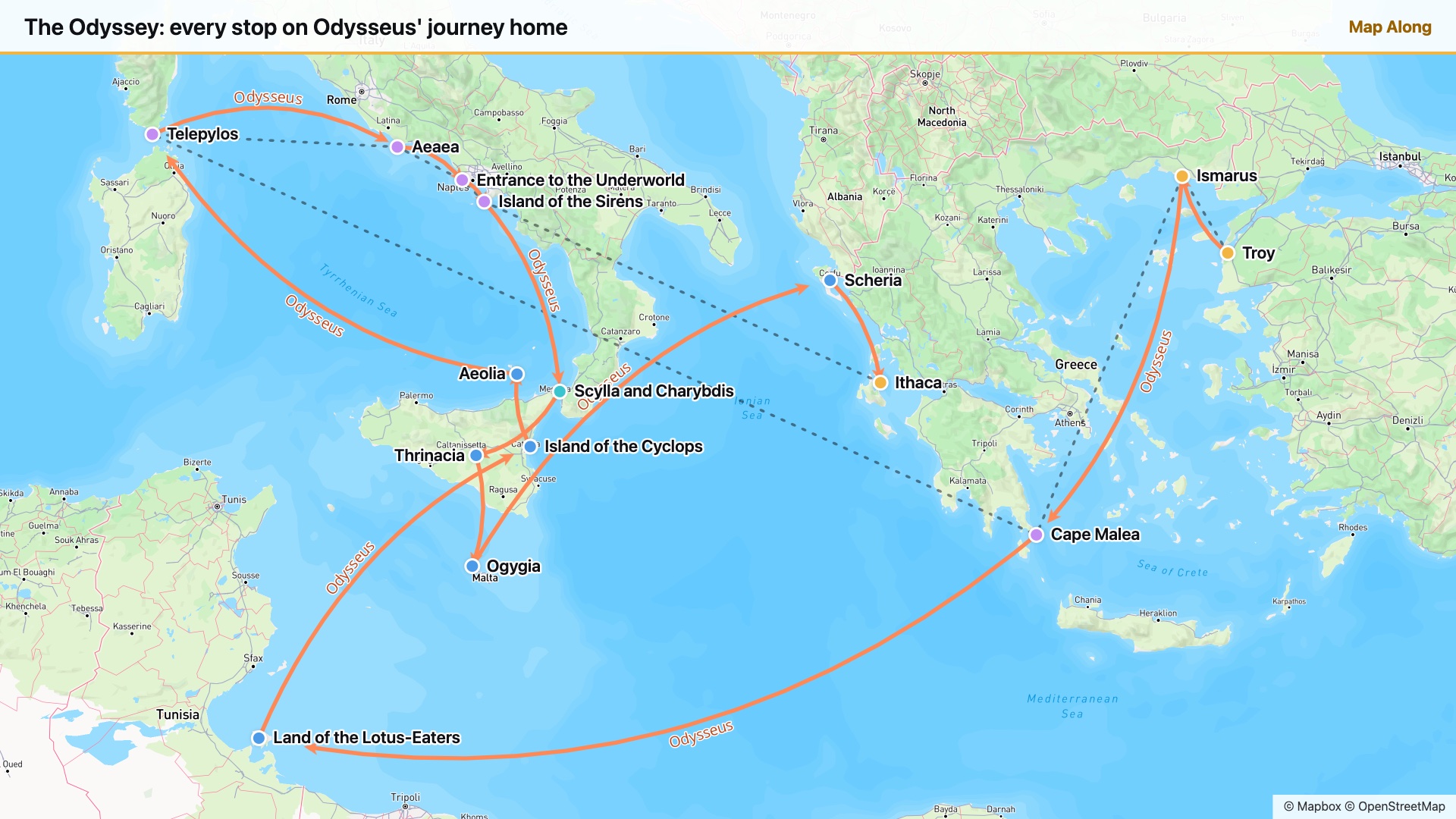
Made with Map Along, a Chrome extension that pins every place a YouTube video mentions as you watch. Open any Odyssey video and you get a map like this one, synced to the narration. Add to Chrome
Every stop, from Troy to Ithaca
Stops 1 to 12 are told by Odysseus himself, as a flashback, at the court of the Phaeacians in Books 9 to 12. Where a place is mythical, "today" gives the location most often suggested since ancient times.
Troy
Today: Hisarlik, Turkey · Book 9
The Greeks have won the Trojan War. Odysseus, king of Ithaca, sets sail for home with twelve ships.
Ismarus, land of the Cicones
Today: near Maroneia, Greece · Book 9
The crew raids the city, then stays too long feasting. The Cicones strike back and kill six men from every ship.
Cape Malea
Today: Cape Maleas, southern Greece · Book 9
Rounding the tip of the Peloponnese, almost home, a north wind blows the fleet off course and out of the known world for nine days.
Land of the Lotus-Eaters
Traditionally: Djerba, Tunisia · Book 9
Men who eat the lotus forget all thought of home. Odysseus drags them back to the ships in tears and ties them down.
Island of the Cyclops
Traditionally: eastern Sicily, near Mount Etna · Book 9
Trapped in the cave of Polyphemus, Odysseus tells him his name is "Nobody", blinds him and escapes under the sheep. His boast as he sails away earns him the anger of Poseidon, the Cyclops' father.
Aeolia, island of Aeolus
Traditionally: Lipari, Aeolian Islands, Italy · Book 10
The keeper of the winds gives Odysseus a bag holding every wind but the one that blows him home. Within sight of Ithaca, the crew opens the bag and the storm blows them all the way back.
Telepylos, land of the Laestrygonians
Traditionally: Bonifacio, Corsica, or Formia, Italy · Book 10
Giant cannibals hurl boulders into the harbour and sink every ship but one. Only Odysseus' own crew escapes.
Aeaea, Circe's island
Traditionally: Monte Circeo, Italy · Book 10
The witch Circe turns his men into pigs. With help from Hermes, Odysseus resists her magic, frees them, and stays a full year.
Entrance to the Underworld
Traditionally: Lake Avernus, near Naples · Book 11
At the edge of the world Odysseus calls up the dead. The prophet Tiresias warns him never to touch the cattle of the Sun.
Island of the Sirens
Traditionally: Li Galli islands, Amalfi Coast · Book 12
The crew plug their ears with wax. Odysseus has himself tied to the mast so he can hear the Sirens' song and live.
Scylla and Charybdis
Traditionally: Strait of Messina, Italy · Book 12
Between a six-headed monster and a whirlpool, Odysseus steers closer to Scylla and loses six men rather than the whole ship.
Thrinacia, island of Helios
Traditionally: Sicily · Book 12
Stuck by contrary winds and starving, the crew kill the Sun god's cattle. Zeus destroys the ship with a thunderbolt. Every man but Odysseus drowns.
Ogygia, Calypso's island
Traditionally: Gozo, Malta · Books 5 and 7
The nymph Calypso keeps Odysseus for seven years and offers him immortality. The gods finally order her to let him build a raft and go.
Scheria, land of the Phaeacians
Traditionally: Corfu, Greece · Books 6 to 8, 13
Shipwrecked again, he is found by the princess Nausicaa. He tells the king his whole story, and the Phaeacians sail him home overnight.
Ithaca
Today: Ithaca, Greece (debated) · Books 13 to 24
Disguised as a beggar, Odysseus finds his house full of suitors courting his wife Penelope. He strings his old bow, wins her contest and takes back his home.
How accurate is this map?
Troy, Ismarus, Cape Malea and Ithaca are real places Homer's audience knew. Once the storm at Cape Malea blows Odysseus off the edge of the known world, the poem becomes a fairy-tale geography, and there is no agreed answer to where the stops really are.
The locations on this map are the traditional ones. Most go back to ancient Greek and Roman writers: Thucydides put the Cyclopes in Sicily and the Phaeacians on Corfu, and the Romans already called the headland south of Rome Circeo after Circe. Other scholars have argued for routes through the Atlantic or the Black Sea. Even Ithaca is debated: some researchers think Homer's Ithaca was part of Kefalonia, next door.
Watch the Odyssey with this map
Map Along builds a map like this from any video as you watch it, pinning each place at the moment the narrator says it. Try it on one of these:
 Classics Summarized: The OdysseyOverly Sarcastic Productions · 6.8M views
The whole story in fourteen funny minutes.
 Everything you need to know to read Homer's "Odyssey"TED-Ed · 3.9M views
Five minutes before you start the book.
 The Odyssey Explained In 25 MinutesThe Life Guide · 9.8M views
Every episode of the journey, told in order.
 Video SparkNotes: Homer's The Odyssey summaryVideoSparkNotes · 1.4M views
The quick revision version for exams.
For teachers
Download the full-size map; it is 1920×1080 and fits a 16:9 slide. After a video, students can take a quiz on it or try to place each stop on a blank map. To make a map like this from any other video, see maps for your slides.
Questions
How long was Odysseus' journey home?
Ten years, after ten years of fighting at Troy. Seven of those years he spent on Ogygia with the nymph Calypso, and one on Aeaea with Circe.
Are the places in the Odyssey real?
Some are: Troy, Ismarus, Cape Malea and Ithaca are real places. The wandering stops, like the Cyclops' island or Circe's Aeaea, are mythical. Since ancient times people have matched them to real coasts, and this map shows those traditional identifications, but no one can prove them.
Is modern Ithaca the Ithaca of the Odyssey?
Probably, but it is debated. Homer's description of Ithaca as the furthest island to the west does not quite fit the modern island, and some researchers argue that Homer's Ithaca was part of nearby Kefalonia.
Can I use this map in class?
Yes. Download the full-size image and use it in lessons, slides and handouts. Keep the Mapbox and OpenStreetMap credit in the corner.
Every place in a video, on the map
Map Along works on any YouTube video: history, mythology, travel, documentaries. New accounts get 3 videos free. See pricing.