
Marco Polo's route: the journey to China and back
In 1271 a 17-year-old Venetian set out with his father and uncle for the court of Kublai Khan. He came home 24 years later, by sea. Here is every major stop on the way, in order: where each place is today, and what Marco Polo said about it.
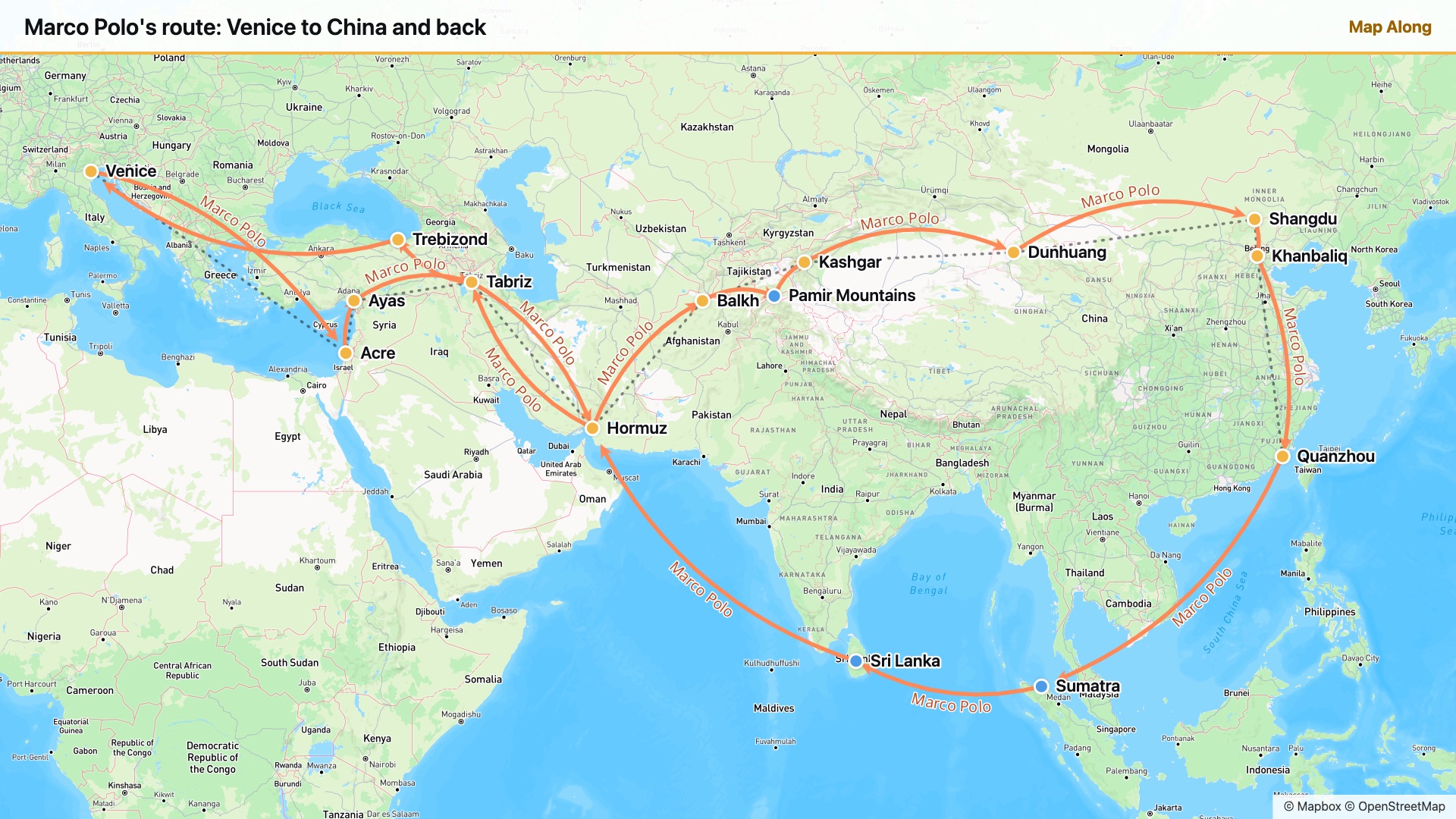
Made with Map Along, a Chrome extension that pins every place a YouTube video mentions as you watch. Open any Marco Polo video and you get a map like this one, synced to the narration. Add to Chrome
Every stop, from Venice to Beijing and home
Stops 1 to 11 are the journey out, mostly along the Silk Road. Stops 12 to 15 are the voyage home, which passed through Hormuz and Tabriz a second time.
Venice
Today: Venice, Italy · 1271
Marco sets out with his father Niccolò and uncle Maffeo, merchants who had already been to Kublai Khan's court once and promised to return.
Acre
Today: Akko, Israel · 1271
The Polos collect holy oil from Jerusalem for the Khan, and letters from the newly elected Pope Gregory X, whom they had met here.
Ayas
Today: Yumurtalık, Turkey · 1271
A busy port of the Armenian kingdom of Cilicia, where goods from the East were loaded onto Venetian and Genoese ships. From here the Polos head inland.
Tabriz
Today: Tabriz, Iran · 1272
A great trading city of Mongol Persia. Marco describes its silks and gold cloth and the merchants who came from India and beyond.
Hormuz
Today: near Minab, Iran · 1272
The Polos planned to sail to China from here, but the ships, sewn together with coconut fibre, looked too risky. They turned north and went over land instead.
Balkh
Today: Balkh, Afghanistan · 1272
Once called the mother of cities, still in ruins from Genghis Khan's armies fifty years earlier. Marco fell ill in nearby Badakhshan and spent a year recovering in the mountain air.
Pamir Mountains
Today: Wakhan, Afghanistan and Tajikistan · 1273
The roof of the world. Marco notes that fire burns weakly up here, and describes wild sheep with huge curling horns, now called Marco Polo sheep.
Kashgar
Today: Kashgar, China · 1273
An oasis city of gardens, vineyards and cotton fields, and the gateway into the Tarim Basin.
Dunhuang
Today: Dunhuang, China · 1274
After a month crossing the desert near Lop Nur, where Marco heard tales of spirit voices that lured travellers away, the Polos reach the province he calls Tangut.
Shangdu
Today: Inner Mongolia, China · 1275
Kublai Khan's summer capital, with a marble palace and a vast park. Marco's description later inspired Coleridge's poem "Kubla Khan" and the name Xanadu.
Khanbaliq
Today: Beijing, China · 1275 to 1291
The Khan's capital. Marco serves Kublai for about 17 years and marvels at paper money, the postal relay system and coal, "black stones" that burn.
Quanzhou
Today: Quanzhou, China · 1291
Marco's Zaitun, one of the busiest ports in the world. The Polos sail from here with 14 ships, escorting the Mongol princess Kököchin to marry the ruler of Persia.
Sumatra
Today: Aceh, Indonesia · 1292
The fleet waits five months here for the monsoon winds to turn. Marco describes rhinoceroses, which he takes for unicorns and finds disappointingly ugly.
Sri Lanka
Today: Sri Lanka · 1292
Marco calls it the finest island of its size in the world, famous for rubies, and tells of Adam's Peak, a mountain sacred to several faiths.
Trebizond
Today: Trabzon, Turkey · 1295
After delivering the princess at Hormuz and resting in Tabriz, the Polos reach the Black Sea, sail on through Constantinople and arrive home in Venice in 1295.
How accurate is this map?
Every stop is a real place, shown at its real location. The exact path between them is less certain: Marco's book is organised by region rather than as a day-by-day diary, so historians reconstruct the route from the order of his descriptions. Hormuz is mapped at the old mainland city near Minab, which moved to Hormuz Island around 1300.
Some places in the book, like Japan, he describes from hearsay, so they are left off the map.
Watch Marco Polo's journey with this map
Map Along builds a map like this from any video as you watch it, pinning each place at the moment the narrator says it. Try it on one of these:
 The Travels of Marco Polo - Summary on a MapGeo History · 1.7M views
The whole journey in eleven minutes.
 Marco Polo: The World's Greatest ExplorerBiographics · 830K views
His life before and after the journey.
 History-Makers: Marco PoloOverly Sarcastic Productions · 724K views
The funny version, with the doubts included.
 The Adventures of Marco PoloThe History Guy · 169K views
A short, calm retelling.
For teachers
Download the full-size map; it is 1920×1080 and fits a 16:9 slide. It pairs well with the Silk Road map. After a video, students can take a quiz on it or try to place each stop on a blank map. To make a map like this from any other video, see maps for your slides.
Questions
How long was Marco Polo's journey?
24 years. He left Venice in 1271 at 17, reached Kublai Khan's court around 1275, served the Khan for about 17 years, and was home in 1295.
Did Marco Polo really go to China?
Most historians think so. Some have doubted it because his book never mentions tea or the Great Wall, but his details of Yuan paper money, salt revenues and the princess's voyage to Persia match Chinese and Persian records.
How did Marco Polo's book get written?
A few years after his return he was held prisoner in Genoa, where he told his story to a fellow prisoner, the writer Rustichello of Pisa. The book, known as The Travels or Il Milione, became one of the most read books in medieval Europe.
Can I use this map in class?
Yes. Download the full-size image and use it in lessons, slides and handouts. Keep the Mapbox and OpenStreetMap credit in the corner.
Every place in a video, on the map
Map Along works on any YouTube video: history, travel, geography, documentaries. New accounts get 3 videos free. See pricing.