
Ibn Battuta's travels: the journey from Tangier to China
In 1325 a 21-year-old law student left Tangier for Mecca. He came home 24 years later, after reaching China, and then set off again for Spain and the Sahara. Here is every major stop on the longest journey of the Middle Ages.
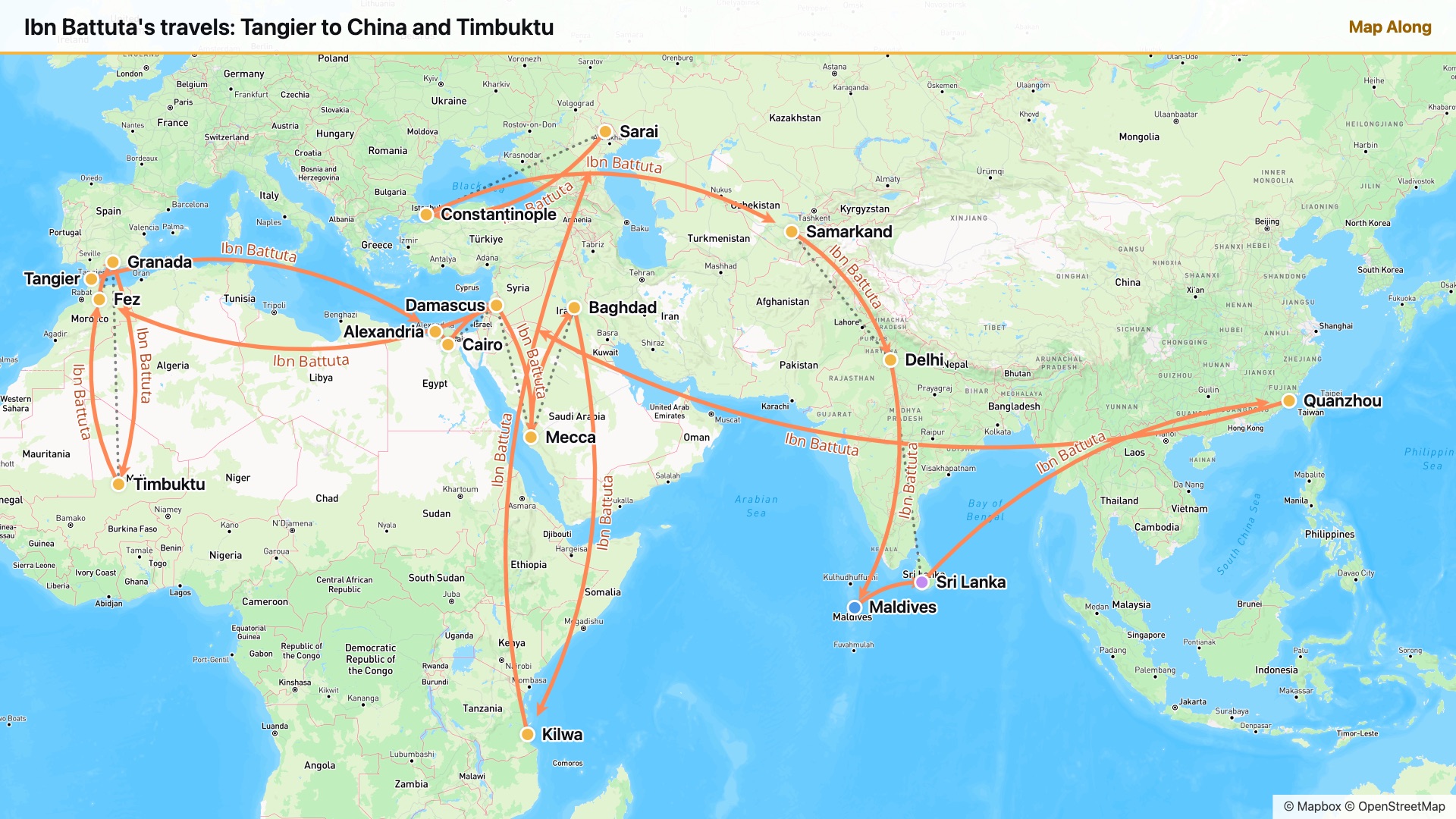
Made with Map Along, a Chrome extension that pins every place a YouTube video mentions as you watch. Open any Ibn Battuta video and you get a map like this one, synced to the narration. Add to Chrome
Every stop, from Tangier to Timbuktu
Dates are approximate. Ibn Battuta told his story from memory years later, and scholars still argue over the exact order of some trips.
Tangier
Today: Tangier, Morocco · 1325
He leaves home alone, on a donkey, to make the pilgrimage to Mecca. He later says he cried at leaving his parents.
Alexandria
Today: Alexandria, Egypt · 1326
He admires the great lighthouse, already half in ruins. A holy man here predicts that he will travel to India and China.
Cairo
Today: Cairo, Egypt · 1326
The largest city he has ever seen, which he calls the mother of cities, crowded with boats on the Nile.
Damascus
Today: Damascus, Syria · 1326
He spends Ramadan here studying, and joins the pilgrim caravan south to Mecca.
Mecca
Today: Mecca, Saudi Arabia · 1326
He completes the hajj, and instead of going home decides to see the rest of the Muslim world. He will return to Mecca several times.
Baghdad
Today: Baghdad, Iraq · 1327
A city still recovering from the Mongol sack of 1258. He travels part of the way with the Mongol ruler of Persia's royal camp.
Kilwa
Today: Kilwa Kisiwani, Tanzania · around 1331
Sailing down the Swahili coast past Mogadishu and Mombasa, he reaches Kilwa, which he calls one of the most beautiful and well-built towns in the world.
Sarai
Today: near Astrakhan, Russia · around 1332
The capital of the Golden Horde on the Volga. He joins the moving camp of Uzbeg Khan, a city of wagons that travels across the steppe.
Constantinople
Today: Istanbul, Turkey · around 1332
He escorts one of the Khan's wives, a Byzantine princess, home to visit her father the emperor, and becomes one of very few Muslim travellers to describe the city from inside.
Samarkand
Today: Samarkand, Uzbekistan · around 1333
Back across the steppe and south through Bukhara, he finds Samarkand's great buildings still partly in ruins from Genghis Khan's time.
Delhi
Today: Delhi, India · 1334 to 1341
Sultan Muhammad bin Tughluq makes him a judge with a huge salary. He stays about seven years, until the unpredictable sultan sends him as ambassador to China.
Maldives
Today: Maldives · 1343 to 1344
After his embassy fleet is wrecked off India, he ends up in the Maldives, where he serves as chief judge for about a year and marries into the ruling family.
Sri Lanka
Today: Adam's Peak, Sri Lanka · 1344
He climbs Adam's Peak to see the giant footprint at the summit, sacred to Muslims, Buddhists and Hindus.
Quanzhou
Today: Quanzhou, China · 1345
By way of Bengal and Sumatra he reaches Zaitun, a port he calls one of the largest in the world, with hundreds of great junks in the harbour. He is impressed by Chinese paper money and porcelain.
Fez
Today: Fez, Morocco · 1349
Heading home through India, Persia and Damascus, he lives through the Black Death in Syria and Egypt, and reaches Fez to learn that his mother has died.
Granada
Today: Granada, Spain · 1350
A short trip across the strait to al-Andalus, the last Muslim kingdom in Spain.
Timbuktu
Today: Timbuktu, Mali · 1352 to 1353
His last great journey, by caravan across the Sahara to the Mali Empire, made famous by the wealth of Mansa Musa. Then he goes home to Fez for good.
How accurate is this map?
Every stop is a real place, shown at its real location. The lines are simplified: he often went back and forth, visited Mecca several times, and made side trips that would turn the map into a tangle, like Anatolia, Crimea, Bengal and Sumatra. His book, the Rihla, was written down years later from memory, and a few sections, like his trip north to Beijing, are doubted by historians. Those are left off.
Watch Ibn Battuta's journey with this map
Map Along builds a map like this from any video as you watch it, pinning each place at the moment the narrator says it. Try it on one of these:
 How did Ibn Battuta Explore the World?Knowledgia · 2.8M views
The whole route in seventeen minutes.
 Ibn Battuta - The Great Traveler - Extra History - Part 1Extra History · 1.5M views
The start of a well-loved animated series.
 Ibn Battuta | History's Greatest Traveler | Extra History CompleteExtra History · 804K views
All the episodes in one.
 Ibn Battuta: The Greatest Traveller in History?History Time · 364K views
A seven-minute overview.
For teachers
Download the full-size map; it is 1920×1080 and fits a 16:9 slide. Compare it with Marco Polo's route: the two travelled some of the same roads fifty years apart. After a video, students can take a quiz on it or try to place each stop on a blank map.
Questions
How far did Ibn Battuta travel?
About 117,000 km (73,000 miles) over 29 years, from 1325 to 1354. That is roughly three times as far as Marco Polo, and more than anyone else is known to have travelled before the age of steam.
Why did Ibn Battuta start travelling?
He left Tangier at 21 to make the pilgrimage to Mecca. Once there he decided to keep going, and set himself the rule of never taking the same road twice if he could help it.
How do we know about his journey?
After he returned for good, the Sultan of Morocco had him dictate his travels to the scholar Ibn Juzayy in Fez. The book is known as the Rihla, which simply means "the journey".
Can I use this map in class?
Yes. Download the full-size image and use it in lessons, slides and handouts. Keep the Mapbox and OpenStreetMap credit in the corner.
Every place in a video, on the map
Map Along works on any YouTube video: history, travel, geography, documentaries. New accounts get 3 videos free. See pricing.